

Daz
-
Joined
-
Last visited
Posts posted by Daz
-
-
-
-
-
-
Feeding
If you are not sure of how much seed to give your bird daily, a heaped teaspoon per day per bird will give you a good starting point, and evaluate what is left in the dish and adjust accordingly.
A good basic mix of 50% canary seed, 25% white millet and 25% Japanese millet is a good start, which you can alter to suit your own situation, some other seeds that can be added are, sunflower, oats, or groats. There are more, but these will be quite sufficient to keep your birds very well.
Many breeders are in the habit of reclaiming or cleaning seed by winnowing it.
"This is a process of removing the rubbish from leftover seed by means of sifting or blowing air over it"
If you use a pre- mixed seed be very aware that the birds have most likely taken more of one type of seed out of the mix, and the re-cleaned seed you are returning to your bins will more than likely be deficient in one or more types of seed.
It is a good habit to top up the mixture to retain that balance.
As an alternative to the birds usual diet, try placing a measure of your usual bird mix in a old stocking, and soak in boiling hot water in a bucket for an hour. Leave this to dry out for 24 hours, and as it starts to germinate, give it to the birds, they will love it, by the way, take notice of the dirty water in the bucket.
Grit is a debated topic in the aviaries, but we like to give our birds the options of many things to eat, so the grit we use is a mixture from different sources, and includes shell grit our club obtains from an inland lake, added to commercial pigeon grit and coarse sea sand that we obtain up on our local beaches, plus a mix we get from Broken Hill, which is a by product of the mines , the mix is 1/4 part of each.
It is a good idea to procure all of your own ingredients for your grit mixture, find a nice balance and keep it freshly supplied to your birds.
Greenfeed is a very important item in the diet. Spinach, silver beet or English lavender is very good, chickweed is excellent, and another item we use is Lemna.
Any green feed fed to your birds should be thoroughly washed before you give it to them. Suspend it from the wire using a plastic clothes peg if possible, and they will enjoy it more. There is an article on Lemna on our site
Seed Storage.
A useful addition to the bird room is a obsolete chest freezer.
Remove the power cords and clean thoroughly inside and out.
If you want to divide it into sections for different seeds, it is not hard to do, panel board cut to size works well. A small bag of naphthalene flakes taped to the lid will keep seed fresh and lice or mite at bay, the top of the freezer is also an ideal work bench in the bird room.
-
I agree with Rainbow, It's best to let the cock raise it.
We use a BBBBB = Bruised and Battered Baby Budgie Box. It's a box that sits in the corner of the breeding cage. It has a couple of holes the same size as the holes in a nest box. For the hen or cock to kill the chick they usually gets on it's back and goes through the back of the head. This box stops that. The chick can still be feed and is not in the way of the hen. It can leave the box and feed when it feels up to it.
-
-
Edited by daz
"Feeding & Weaning Chicks"
Once hatched, the nest box must provide a secure home for the first thirty to thirty five days of a chicks life. Initially, the hatchling is fed only crop milk from the hen. As other hatchlings emerge from the egg at a rate of approximately one every other day, the youngest/smallest is fed first, with progressively larger hatchlings being fed in sequence. The consistency, texture and ingredients of the crop milk fed vary from the youngest to the oldest chick.
Occasionally a hen will not feed a newly hatched chick. This is often especially true of immature or inexperienced hens. If within an hour or two of hatching, you cannot observe a small whitish patch or bulge in the chick's crop it has probably not been fed. A useful tip is to take a youngster that is 3 to 6 days old from another nest and place it in the box with the unfed chick. This older chick which is stronger, louder and more demanding of being fed, will usually, stimulate the hen to feed. Once she does, she will also feed the younger chick.
If an older chick is not available, administer a couple of drops of warm lactated milk solution with 20% dextrose or pedialyte to the unfed chick. It is usually enough to strengthen it and sustain it until the hen is stimulated to feed.
One additional action needs to be taken if the hen still will not feed the chick. Locate a nest in which an egg is about to hatch (17 to 19 days) and foster the chick to this nest. Usually, most hens are accommodating and are easily fooled into thinking this is their own newly hatched chick.
When all of the chicks have progressed to the point that partially broken down foodstuffs from the crop have replaced the previously pure and mixed crop milk, the cock becomes more active in feeding not only the hen but the chicks also. By the time each chick is about ready to exit the nest box, the cock has normally replaced the hen as the primary feeder, although she too is still active in the process.
Weaning
Weaning; the process of progressing from dependent feeding to independent feeding, takes place over a span of approximately 55 days. At about 3½ to 4 weeks Budgerigar chicks consume limited amounts of food but they do not eat enough to survive on their own without supplement from the parent. By about 6 to 6½ weeks, the chick is able to sustain itself, although there is some weight loss.
While very little has been written about the weaning process in Budgerigars, weaning in Cockatiels appears to be a process brought about by maturation and development rather than through learning or deprivation. Efforts to speed up the process by reducing the amount of food fed by hand resulted in increased begging behaviour rather than increased eating behaviour. It was not until the chicks had matured to the point that they could alter their behavioural response of increased begging to increased eating that they could be weaned. Learning also appeared to be of little importance as chicks, which had no prior experience with voluntary food or water intake, weaned rapidly when presented with food and water at the expected weaning age. One third of the chicks with no prior experience of eating on their own or seeing other birds eat, weaned immediately upon presentation of food.
The only factors, which seemed to influence weaning age, were the growth rate and body weight at between 8 and 30 days of age. Even though at 35 days of age all chicks had achieved about the same weight, chicks which grew faster and weighed more during the 8 to 30 day period weaned more rapidly than those which weighed less and grew more slowly during the same time periods.
As it is highly likely that weaning in Budgerigars closely assimilates that of Cockatiels, do not be in a rush to separate the chick from its feeding parent. You will be able to see a diminished begging response and increased eating response as the chick matures, a process that we are not likely to speed up. Then, and only then is it advisable to remove the chick to separate quarters.
Many experienced breeders when making this transfer, prefer to move a group of similarly weaned chicks at the same time. This way, the odd chick that may not be totally weaned will often receive a supplemental feeding from another of its age group who is stimulated by the begging response. It is also good practice to have a steady, older cock in the weaning cage to show the youngsters “the ropes”.
Hand Feeding
On occasion, you may find yourself with a chick that has not been weaned and without a parent or more matured offspring that will feed it. It is too late to foster as once a chick has feathered it will be perceived as an intruder and attacked if placed in another breeding cage. This is true even if there are other same age youngsters in that cage. The remaining option is hand feeding until it is able to feed itself.
Hand feeding Budgerigar chicks is not a difficult process. Commercial formulas are readily available in most pet shops and any that work for Cockatiels will work for Budgerigars. Mix a level teaspoon full for an individual chick according to the instructions. Using a syringe with a one inch long soft rubber/plastic tube attached to the end draw up the mixed formula. Take the chick in your left hand with its back in the palm, thumb and forefinger on each cheek, and remaining three fingers across its chest and abdomen with your little finger just above the legs. As you are looking at the bird, the tubing is passed over the tongue and down the left side of the oesophagus into the crop. You will feel the tube as it touches the bottom of the crop. Eject the formula and remove the tube.
The Second Round
The second round of breeding is generally in progress at about the time that the fully fledged chicks begin to leave the nest box (between 4 and 4½ weeks). While eggs may or may not have been laid, mating behaviours and copulation most probably have begun. While the process used to protect chicks from attacks by parents is described in another Chapter of this book, this is often the time that attacks are most likely to happen. One indicator that some aggressiveness is already occurring is that you will find small areas on the back of the head of one or maybe more chick where it appears that several feathers are missing. What has actually happened is that the hen has been pecking at the chick in order to force it out of the nest box or out of her ‘territory’. If you have not done so already, this is the time to take the recommended actions to protect the chicks.
One method is to remove the hen, when the first chick emerges from the nest box as it affords the breeder the opportunity to assess the results of the first round before a second round is begun. If you are satisfied that the pair has produced the quality or features that was expected, pair them together again. If for some reason you are not satisfied with the offspring, the hen has already been separated from her mate long enough to diminish the pair bond. As she is rested and ready to begin a new round, you have a better chance of her accepting a new mate that may produce the improvements you are seeking.
-
Edited by daz
Assuming the beginner has been in the hobby for a couple of years and now wishes to progress, how does one go about acquiring the knowledge to breed the winners on the show bench? A Beginner probably has a small shed say an 8ft6ft, which is rather small for breeding.
Let us assume the small shed is not suitable for altering; I would not discard it, you will find, if re-erected in a corner, that it will be ideal for storing nest boxes, show cages and possibly seed etc.
Bigger Shed Required I think the minimum size possible would be a 12ft x 8ft. The door would be better in one end, off-centre, so as cages could be constructed on the back wall. The window should be in the centre of the 12ft length opposite to the cages and should at least one opening light and this will act as a bob-hole to an outside flight, if and when one is erected. If not, ensure the full extent of the window is covered with some form of wire netting. At the time of erecting the new shed, some thought should be given on the provision of a roof light; it can easily be done in the early stage of erection. However ensure whilst doing so that you do not let it encroach onto the space allocated for your cages. Building Your Cages As said previously; erect your cages on the back wall. You should get 4 cages roughly 3ft long, and if you have 3 rows that would give you 12 breeding cages. Which should be enough for most beginners? The cages should be approx 18" depth and the same in height.
On the front wall you can erect a flight say 3ft in width and I would suggest, instead of going from floor to ceiling, you should consider building cupboards in the bottom say about 30" high. This space is so handy for storing seed etc, and you will find that the birds do as well as if it were right to the floor. When you build the flight do not forget to have access doors, to enable the birds to be caught and making feeding easier. I would consider at least two doors, not too high, or you will find the birds will fly over your head.
The combined width of flight and cages is around 4' 6" leaving a corridor of approx 3' 6". This you may think is too wide, but I assure you, you will find that it is just right, especially if you have your nest boxes hanging on the outside of the cages. Remember, the day will come when you will have visitors, and you will then appreciate the additional width. Nest-boxes come in all sizes and designs, choose a type to suit yourself, birds seldom have preferences. Feed the best quality seed available, it is false economy to feed cheap seed. Where possible have some type of floor covering, it not only looks good but it is also so much easier to clean. Now comes the crunch. The initial stock you started with we can assume was not good enough for exhibition purposes so where do we get new stock from?
Don't Rush into Buying Take your time. Do not rush into buying the first birds offered to you. Study the show results and see who is winning in breeders' classes. In the first year I would ignore the champions, not only would their prices be much dearer than say a good novice, but the quality of stock offered may be too good for the raw beginner. It takes time and experience to manage a stud properly and the expensive bird from a champion needs expert management to achieve the best results. I honestly consider it is best to find a good novice with good breeder birds. Try where possible to get two or three pairs with some related birds if possible. Pair them together the first year, and if the youngsters are good or better than the parents, you have done well. The second year, you can start crossing the youngsters, but one word of warning, ensure that only the best are used. Re-invest Your Money If your breeding was reasonable; you should have a few birds you could sell. Anything you feel is not up to standard, sell if possible. But the true facts of life are that you will have extreme difficulty in selling at a fraction of the price you paid. You will likely have to sell anything up to eight birds for the price you will have to pay to get better stock in. Unfortunately, that is how it works. Do not be too downhearted, we all have had to go through the same process. Even now I have to sell a few before I have the cost of a replacement. I hope I have not put you off, remember it is a great hobby and | you can get a lot of enjoyment from it. The exhibition side is wonderful. The thrill you will experience when the first rosette is pinned on the cage is great. However you will also be a loser. Be a good loser, because your turn will come.
-
-
-
Sounds like s/he is going well. But all chicks have pink ceres.

I usually sex them about 21 days old.
How to post photos. Hope this helps.
-
Edited by daz
SHOW RULES OF THE AFFILIATED SOCIETIES
OF THE SOUTH QUEENSLAND BUDGERIGAR
BREEDERS ASSOCIATION INC.
1 EXHIBITOR STATUS
1.1 There shall be the following three classifications of exhibitor:
i) Open
ii) Intermediate
iii) Novice
These sections to include Junior where applicable.
1.2 Junior classification for exhibitors is from eight (8) years of age until sixteen (16) years of age. From 1st January of the following year the exhibitor will cease to be a Junior exhibitor.
1.3 a. Where two (2) or more exhibitors are co-habiting and BREEDING birds at the SAME address, they shall show in the highest section of any of the exhibitors.
b. On the formation of a partnership of exhibitors, the points carried through will be those of the exhibitor with the higher exhibition status. The other exhibitors points being discarded. If two or more exhibitors of the same exhibitor status form a partnership, the points carried through will be those of the exhibitor with the highest number of points. The partnership must exhibit in the section of the partner with the highest exhibitor status.
c. Upon the cessation of a partnership, the ring numbers of the birds being kept by each member of that partnership must be supplied to their parent club/society/association.
1.4 A person who has not been showing for five (5) years from the 1st of January of the current calendar year may request to their club management committee to drop to the next lowest Section they last showed in.
1.5 Exhibitors showing in either Novice, Intermediate or Open Sections must be approved by an A.N.B.C. Affiliated Society to show in these sections.
2 ENTRIES
2.1 There shall be the following classes in Open, Intermediate and Novice .
AA Any Age (combination of Young & Old Birds excluding Nestfeathers).
A Old Bird (excludes Young & Nestfeather)
B. Young birds (Young birds bred by the exhibitor only)
N/F Nestfeathers (Nestfeathers bred by the exhibitor only)
Purchased Birds: Cannot be shown. Please refer Rule 2.5 a.
2.2 All entries shall be made by telephone, fax, email or on the entry form issued for the purpose and shall be addressed to the Show Manager / Secretary, unless the Society at any meeting shall otherwise direct.
2.3 Entry fees must be paid prior to judging. Cheques or Money Orders shall be made payable to the Association or Society. Fees not paid may automatically disqualify the bird/s from being judged. All birds nominated MUST be paid for, whether such birds are staged or not. Action to recover fees to be at the discretion of the individual Society.
2.4 Entry fees for any show shall be paid for at the rate decided by the Organising Management Committee.
2.5 a. Individual Clubs may have a special section for Novice Exhibitors to exhibit purchased birds. Purchased birds cannot be eligible for normal show awards / show points.
b. In the Open, Intermediate and Novice sections all birds must be rung with the breeders approved closed ring.
c. Young Birds must be rung with the appropriate years ring.
d. All birds eligible to compete in Any Age/Old, Young and Nestfeather classes must be bred and rung in Australia with a single closed ring only which is registered to the exhibitor.
e. Plastic or split rings are not permitted.
The Show Committee will disqualify birds that do not comply with these rules.
(The Show Committee will be as per each individual clubs decision)
2.6 All exhibits must be bona-fide property of the exhibitor on the date of entry. No selling for a limited period or borrowing will be allowed. Birds proved not to be owned by the exhibitor will be disqualified together with the exhibitor and all of their other exhibits.
2.7 All birds eligible to enter in Nestfeather and Young Bird classes must be rung with appropriate years ring, bred by, and in the continuous possession of the exhibitor, who must be a member of an affiliated Club/Association/Society. All exhibits shall be rung with a closed metal A.N.B.C. approved ring supplied by the Club/Association/Society and registered. (Closed and coded rings are issued after the 1st January of each year).
2.8 After the entries have been received a label for each cage will be supplied to the exhibitor, who shall affix it on the bottom rail at the right hand corner of the cage. No other distinguishing marks may appear on the cage, unless an additional label has been approved by the Show Manager / Secretary.
2.9 a. No bird may compete in more than one class.
b. Reclassification of birds is at the discretion of individual societies.
c. If not covered by 2.9 B. birds entered in a wrong class will be disqualified see “rule 9 page 41 ANBC standard”
2.10 The Committee shall take all reasonable care of the exhibits, but the Association/Society or the Committee will not be responsible for any accidents, losses, mistakes, or damages from whatever cause arising. The birds being shown are at the sole risk of the Exhibitor.
2.11 No entry shall be accepted from any person disqualified by this or any other Club/Society/Association during the period of disqualification.
2.12 Bird dealers may exhibit but only as individuals or partnerships and not as a bird shop or under a trade name.
3 SHOW CAGES
3.1 All exhibits must be staged in recognized ANBC standard show cages with no visible identifying features.
3.2 Birds shown in poorly maintained cages will be disqualified by the Show Committee.
3.3 a. Round white drinkers on A.N.B.C. standard show cages MUST be placed between the 4th and 5th bars on the left hand side of the show cage as viewed from the front.
b. Perches MUST be positioned eight (8) bars in from either side of the show cage, with the groove at the end of the perch to run vertically.
3.4 Floor covering for all cages shall be a standard seed mixture suitable for budgerigars. Shell grit or other distinguishing matter will not be accepted. The use of plastic “cage savers” under the seed is optional (as per A.N.B.C. Council meeting May 2004). Contravention of the rule will result in the exhibit being disqualified.
4 SHOW DAY
4.1 All exhibits must be at the show at the time appointed by the Club/Society/Association. (In unforeseen circumstances, allowances maybe made at the Show Managers/Secretary discretion)
4.2 No exhibitor shall be admitted to the staging area before the completion of judging, except to deliver exhibits to the stewards. As soon as the stewards take possession of the exhibits, the person must retire from the staging annex and the judging area.
4.3 a. During the show all exhibits will be in the custody of the Show Committee and may not be touched or handled by the owner, or any other person, under any pretence whatsoever without the permission of the Show Manager/Secretary or the Assistant Show Manager / Secretary. Not withstanding anything stated above, the birds will remain at all times the property of the owner.
b. Whilst judging is in progress no person or persons other than Judges, Show Committee and Stewards for that section, will be permitted in the judging area.
4.4 Any unauthorized person removing a bird from the show room without permission during the progress of the show shall automatically have their exhibits disqualified and shall forfeit all trophies, sashes or cards that otherwise they may have been entitled.
4.5 The Show Committee reserves the right to inspect any bird at any time during the course of the show for any purpose it deems necessary.
4.6 The Club/Society/Association Committee reserves the right to refuse any entry or entries at any time and shall not be bound to assign any reason for such refusal.
4.7 Ring numbers or code of all breeders’ exhibits must be supplied upon request.
4.8 Only members of the Club/Society/Association with birds rung with the Society’s rings will be eligible to compete for Society rung trophies.
5 JUDGING
5.1 Budgerigars will be judged according to the latest standards adopted by the Australian National Budgerigar Council.
5.2 Judges must be selected from the South Queensland Judges Association Inc. panel however in certain circumstances, recognized visiting Guest Judges (e.g. international or interzone) may be appointed at the discretion of the Committee, provided the birds are judged to the ANBC standard. Special permission to invite Guest Judges must first be obtained from the South Queensland Judges Management Committee Inc.
5.3 The decision of the Judge or Judges shall be final upon all matters of merit.
5.4 No exhibitor shall be allowed to assist the judge in their section should they have entries in that section, unless no other stewards are available.
5.5 Judges shall not be allowed in the staging or judging area until judging commences.
5.6 Any bird marked 'no award' or ‘NA’ shall not be removed from the show bench
5.7 a. Only birds attaining a first placing in their class are eligible for further awards except in a reserve award situation.
b. If any bird at the show does not reach a satisfactory standard, awards will be made at the Judges discretion.
Please refer to page 8 Show Rules ANBC “Faults requiring disqualification”
6 DISQUALIFICATION
6.1 Birds rung with 2 closed rings shall be disqualified along with the exhibitor and all of their other exhibits.
6.2 Any faking, trimming of flights and tail feathers, dyeing of feathers or any other show practice considered improper by the Show committee shall not be allowed. Any exhibitor found to have done so shall have all entries disqualified for the Show.
6.3 a. The Judge of an exhibit may initiate disqualification if in their opinion it is in breach of Rule 6.2. Notice in writing, signed by the Judge must specify the reason and be given to the Show Manager or other authorized official before completion of judging. The Show Committee or an authorized sub-committee of at least three competent independent persons must examine the exhibit and record its findings.
b. If following this, it is proposed to disqualify the Exhibitor, the Show Committee shall notify the Exhibitor in writing of the intention and reasons. Notice to the Exhibitor shall be given at least thirty minutes before presentation of awards, or if the Exhibitor is absent, within such reasonable time as the Show Committee may direct. The Exhibitor must be presumed innocent unless proven otherwise.
6.4 Any Exhibitor may lodge a protest with the Show Manager/Secretary at any time up to thirty (30) minutes upon completion of show judging against any exhibit or Exhibitor on grounds of violation of any Show Rule. This protest must be in writing signed by the protestor, must specify particulars of the charge and must be accompanied by a deposit of $50.00. This deposit shall be forfeited if the Show Committee decides the protest is frivolous, vexatious or unjustified but otherwise may be returned to the protestor.
The Show Committee or an authorized sub-committee of at least three competent independent persons must examine the exhibit, if appropriate, and record its findings. If the Show Committee considers it should proceed with the protest, it shall so inform the Exhibitor if he or she is available. Upon acceptance of the protest the Show Committee shall promptly notify the exhibitor against who the protest has been lodged. The exhibitor shall be shown the written protest. The Exhibitor shall be permitted to examine all evidence and answer the charge within such reasonable time as the Show Committee may direct. The Exhibitor must be presumed innocent unless proven otherwise.
6.5 The Show Committee shall disqualify any exhibit against which a protest has been duly lodged and upheld for a show rule violation.
6.6 Any Exhibitor found by the Show Committee to have made a dishonest entry for any exhibit shall forfeit all awards won by that exhibit at the Show concerned and will be disqualified. The Show Committee shall determine whether such disqualification shall extend to all of that exhibitor’s entries at that Show.
6.7 If an exhibit is disqualified, the Show Committee may also disqualify the Exhibitor. Any Exhibitor so disqualified shall forfeit all awards won at the show.
6.8 If within thirty (30) minutes of completion of judging, a bird is disqualified, affected classes shall be re-judged as required and awards re-distributed as necessary.
6.9 Any one found guilty of attempting to bribe a judge shall be disqualified for a period of not less than five (5) years. The S.Q.B.B.A. Inc and all affiliated Clubs/Societies/Associations will be informed of such suspension.
6.10 Any breach of any show rules that necessitates suspension of an exhibitor for any period of time must be reported to S.Q.B.B.A. Inc. and all affiliated Clubs/Societies/Associations.
7 GENERAL BEHAVIOUR
7.1 a. All persons causing annoyance by comments on decisions of Judges or other unseemly or insulting behaviour, after being cautioned by a member of the Show Committee, will be expelled from the Show or otherwise dealt with by the Committee as they shall think fit.
b. An exhibitor who speaks or comments within the judges hearing or makes an approach to the judge regarding exhibits in the class being judged will be dealt with by the Show Committee as they see fit.
8 GENERAL
8.1 Exhibitors may bring birds for sale at the discretion of the society. The individual Club/Society/Association shall determine commission and Entry Fee. The Committee will take all reasonable care of the exhibits, but the Society or the Committee will not be responsible for any accidents, mistakes, losses, or damages from whatever cause arising.
9 DISEASE AND ILLNESS
9.1 Any bird having an apparent disease or complaint shall not be admitted to the show.
9.2 a. The Show Manager or Delegated person shall remove from the show bench any bird becoming unwell during the Show.
b. Should a bird require immediate attention, permission should be granted for its removal from the show venue upon application to the Show Manager.
10 SHOW POINTS / ELEVATIONS
Only 1 point can be awarded to one exhibit at any show.
(Club table shows do not count towards Show points)
10.1 a. In Nestfeather & Young Bird classes in Intermediate and Novice sections, a bird winning in a class of seven (7) or more exhibits benched and not less than four (4) exhibitors = 1 point.
b. In Nestfeather & Young Bird classes in Intermediate and Novice sections a bird winning a colour award of Section between Cocks and Hens and being from seven (7) or more exhibits benched and not less than four (4) exhibitors = 1 point.
c. Any bird winning Best Cock or Hen, or Best bird or Opposite Sex in their section regardless of age and number of exhibitors and entries benched will receive one point.
10.2 a. Any Novice exhibitor accumulating eight (8) points at any one society will be elevated to Intermediate Section provided a minimum of two (2) years has expired from date of joining an affiliated Club/Society/Association..
b. Any Intermediate exhibitor accumulating ten (10) points at this Society will be elevated to Open Section provided a minimum of three (3) years has expired.
c. Any exhibitor who is elevated to a new status will be notified in writing and such elevation will take effect from 1st January of the following year.
d. The Secretary or Show Manager/Secretary of the S.Q.B.B.A. Affiliated Society will duly record a tally of all show points gained by each exhibitor gained at each Society show for the show year. Written notification of elevations is required by S.Q.B.B.A Inc by November 30th each year. S.Q.B.B.A. Inc will notify all affiliated societies by December 31st each year of such elevations.
10.3 No Breeder / exhibitor may elevate themselves. All elevations must be in accordance with the fore- going clauses except where a partnership is formed.
DEFINITIONS FOR SHOW RULES
Colour Class: The allocated number according to the relevant show schedule a bird is to be exhibited in. e.g. Class 1 is for Light Green Cocks: Class 2 –Light Green Hens etc.
Colour Awards: According to the society awards list. E.g. Best Green Normal would be awarded to the best bird from the Light Green, Dark Green, Olive Green and Greygreen Cocks and Hens exhibited in the section.
Variety Award: All birds of the same variety comprising both sexes.
e.g. Normals of both green and blue series for Best Normal Award.
Section: Open: Intermediate: Novice: Junior: (Refer exhibitor status)
Show Year: January 1st to December 31st in one calendar year.
Nestfeather: Current year rung bird. Aged between approx. six to twelve weeks of age that is not displaying any of the following features:
a. solid iris ring
b. broken cap
c. adult colouring on cere
d. multiple pin feathers
e. visible adult feathers in body or wing
Young Bird: When birds have their full adult plumage. A bird will remain a young bird until 31st July the following year. E.g.a bird born on the first January 2004, and rung with a 2004 leg ring, may only be shown as a young bird from 1st August 2004 until 31st July 2005. As of the 1st August 2005, it becomes an Old Bird.
Old Bird: Any bird rung with a previous years’ ring (read description for Young Bird above).
Young Birds cannot be exhibited in this class.
Nestfeathers cannot be exhibited in this class.
Any Age Bird: A combination of Young & Old Birds.
Nestfeathers cannot be exhibited in this class.
Page 41 ANBC Standard
BUDGERIGAR PENALTY AND DISQUALIFICATION CLAUSES FOR GUIDANCE OF A.N.B.C. JUDGES AND EXHIBITORS.
Updated: June 2003
FAULTS REQUIRING DISQUALIFICATION
1. Sickness:
Ruffled, huddled appearance coupled with vomiting, continual shaking or diarrhoea. (not to be confused with nervous vent).
2. Mites or Lice:
Visible on bird or indicated by nodules at the side of the beak, scale on the legs, scale on the cere, ragged black markings on feathers particularly on the side of the birds towards the vent area. (Note: not to be confused with misplaced melanin).
3. Injury / Deformity:
e.g. Dislocated joints, undershot beak, missing toes or part thereof, apparent signs of feather plucking, three or more toes permanently facing forward, inability to grip perch, obvious French moult, more than two primary tail feathers, substantial bleeding.
4. No visible iris ring/s where these are required or vice versa.
5. All brown cere on a cock bird.
6. Both primary tail feathers missing
7. Incorrect varietal characteristics:
Any bird showing characteristics other than those set out in the Standard for the variety they represent
eg Cinnamon characteristics in Clearwings or Greywings, birds with incorrect cere colour.
8. Broken nest feather:
i.e. Adult coloured cere, multiple pin feathers, visible adult feathers in body or wing, broken cap,
solid iris ring.
9. Birds entered in the wrong class.
Note: Birds disqualified by reason of Numbers One or Two above are to be removed from the bench immediately.
CHAMPION STATUS
To gain champion status and be recognised as a Champion Breeder an exhibitor must gain fifteen (15) show points whilst exhibiting young birds in the Open section within a two year time frame commencing January 1st 2005
For the Champion Breeder to maintain this Champion Status the exhibitor must achieve five (5) show points whilst exhibiting young and any age birds in a single showing year.
Show points to be gained as per show points system accumulated from affiliated societies of the S.Q.B.B.A. Inc.
It is the exhibitor’s responsibility to maintain the record of points gained. The points to be verified by the respective Club Show Manager/Secretary in a diary which will be submitted to S.Q.B.B.A. Inc Show Manager when the required points have been accumulated.
An exhibitor failing to meet the champion criteria will automatically revert to open status.
This champion status will not be another show section: it should be worked from points gained by exhibiting in the Open section.
If clubs wanted to have awards for a champion section that would be up to the individual club.
-
The Judge has a "judging Stick" simular to a Drum Stick. He uses it to promt the bird back up to the perch. The same way as you would train a bird to perch on your fingure.
The judge gives the bird no more than 5 minutes of attention before he gives up. He can not judge the bird on the floor of the cage.
-
-
During the course of research work at the University of Liverpool, sponsored by the Lancashire, Cheshire and North Wales Budgerigar Society, it has become obvious that many outbreaks of disease in aviaries are started by buying diseased and unhealthy stock. Many fanciers, when obtaining new out-crosses to improve their studs have in mind the defects in their own birds and the features they want to introduce, but take no regard of the health status of the stud and the healthiness of their proposed purchases. Buying a sick or ill bird is dangerous as, not only can years of work be wiped out but also, with a few diseases, the fancier's own health may be placed in jeopardy.
Assessing the health of the selling stud and individual birds will not totally eliminate the risk from purchased birds as some carry disease without showing symptoms, but it will certainly help. Quarantining purchased birds outside the main birdroom for 3 weeks will also help as the stress of movement, the new environment and quite possibly a change of water and food will often trigger illness in these carriers of disease, so that they can be treated or disposed of without placing the birds in the main room in peril Quarantined birds should be attended to, fed and watered after you have finished your chores in the main bird room.
Health assessment of a stud starts before you get to the bird room. As you are walking down the garden path, listen for the amount of noise from the birdroom, healthy budgerigars make a lot of noise, a quiet bird room is a danger-sign. When you, as a stranger, enter the bird room the birds will be quiet for a few minutes and a little while can be spent chatting to the owner while the birds become used to your presence and the noise starts up again. Budgerigars are active birds, when you enter the bird room they may stop what they are doing, and eye you up with their heads cocked to one side, but their activity should soon resume. If there is not much activity and the birds remain quiet make your excuses and buy elsewhere. If the noise and movement appear satisfactory cast your eye over the seed bowls do they contain seed and husk or has the food been ground to a powder, indicating a digestive problem? Look at the floor of the flights or cages, are the droppings the normal black and white and dry or are they wet, sloppy and an abnormal colour? Look at the birds, are they bright-eyed, their feathers groomed and lying properly and the feathers round the vent free from soiling? If more than a very occasional bird is affected in this way go elsewhere for your out-crosses. Only when you have decided that the stud is healthy, (and a surprising number are not) should you start looking at individual birds.
Having discussed with the vendor the types of birds you are looking for and having picked out a few likely ones he will probably present these to you in show cages for you to make your choice. Are these birds an overall normal shape? How do they behave? Are they bright, alert and upright on the perch or are they skulking on the floor half hidden by the bottom of the cage front? The latter are very probably highly stress-susceptible and are best avoided. A healthy bird will watch what is going on and you can judge this by the way it will turn its head so that one eye is pointing directly at anything moving in its field of view. Some birds are blind in one eye these will always look at you with the same eye, move the bird around the cage with a judging stick to check that it can watch you with both eyes. While looking at the eyes, are they bright and clear? Any sign of redness around the eyes, matting or loss of feathers around the eye and any swelling in this part of the head are signs of disease. You should also check the beak and cere, avoid hens where the cere has grown into a little brown horn and of both sexes in which the cere is not good blue or brown (except in lutinos and albinos where the cere colour is different. Also have a good look at the cere and beak for any sign of scaly-face. Have a look at the bird's feet and legs - does it put its weight equally on both legs or does it hold one off the perch or out to one side; does it grip the perch properly with two toes in front and two behind? Look closely at the feet and lower part of the legs for signs of scaly-face as this part of the bird can also be affected. Also examine the toes for smell pin-head sized swellings - these are a sure sign of kidney problems. How does the bird hold its feathers, all fluffed up or in the normal way which gives a smooth outline to the body? Are the individual feathers of normal shape and more important, are they all there? Missing flights and tail feathers sometimes never re-grow. Are the undersides of the tail feathers clean or covered with droppings of either the black or white variety? The latter ran be a sign of severe internal problems. Are the feathers around the beak on the "chin" and on the top of the head clean or are they matted with vomit? This is not always easy to see, feeling the feathers is often better. While the birds are being shown to you may pass droppings, are these normal or not? Having picked out two or three birds that you are interested in, get hold of them and handle them. Are they of normal weight, too thin (with a prominent keel bone) or too fat (large masses of fat at front and back of the keel bone, easily felt). Is the crop full or empty? Has the bird got a hernia (prolapse), a swelling in the vent region? Consider the bird's age, old hens in particular may take a long time to settle into their new home and may never breed. If the fancier is reluctant to let you handle the birds don't buy.
Don't be pressurised by the selling fancier and don't rush in to buy a bird with features you want without assessing the health of the stud and the individual birds put up for sale. If in doubt don't buy, there are fanciers elsewhere with equally good and healthy, birds.
-
okay I have to ask lol when they hop one it to they stay there?
:hap: I think your mean when they hop on to it do they stay there?
lol more often in my case.. No. :hap: I will need to train them more

This does happen even to the best breeders at time.
Does anyone know where and why the huge elvis hairdos first came into the picture?
Shellball do you mean Crests. I'll let you know I have a history of mutations at home. Or Bubble might have the information in the front of the Australian Standards.
-
Edited by daz
Question if the show birds are put into aviaries are they scared like many other birds that you add into a cage? When being shown they don't look scared? Are they tamed or trained or what lol :hap:.A show bird usually has a more relaxed charactor than the average bird. The chicks are handled often to inspect the growth and look of the birds. The hens rarely bite and not as bad.
The main training is to get them to want to hope on the perch in a show cage. This is done with a special wooden paddle. The bird usually runs back and forth across the bottom of the cage. The paddle is placed as a small hurdle for the bid to hop over, in doing so it see the perch and hopefully hopes on it.
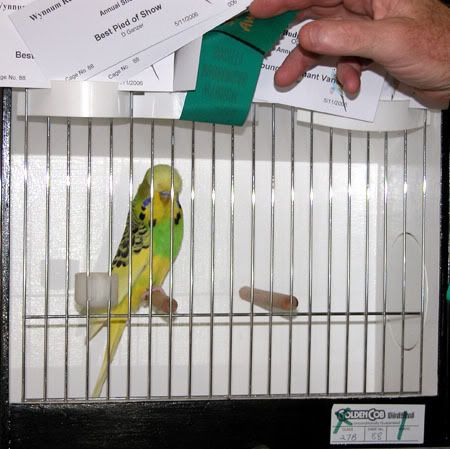
Show Bird in a show cage
- What are the worst and most frustrating aspects of showing and show breeding?a beautiful bird that should win it's class but won't sit on the perch.(won't show). If it won't show it cann't be judged.
- It was vague, but I heard that show budgies are more difficult to breed than the pet type - would that mean that it is harder to meet the breeding requirements for them or that the birds themselves are less eager to breed?
show birds are breed to be in buff. (poofy) When it comes to mating, it is like they have clothes on. The feathers around the vent must be trimmed. to allow mating
- Ideally, what characteristics should someone that wants to get involved in showing have?
a true love of Budgerigars, an open mind, and the required time to look after them and be involved in the show world.
- How time consuming can it become?
I spend 1/2 hour every morning feeding restocking the seed. checking the nests and bird.
I spend 1/2 hour every night changing the water, rechecking the seed and rechecking the nests and birds.
I spend 3 hours on a Saturday cleaning the cages and flights, rechecking the seed and rechecking the nests and birds.
I go to the Club meeting 1 1/2 hours once a month. And try to get to as many shows as I can.
The above is the minimum I'd have to spend. I spend a lot more just standing and watching the birds.
- Are splayed legged chicks more common with show budgies since the female is larger? Are there different precautions that a show breeder needs to take to prevent chicks from becoming splayed? I have never had a splayed chick or hear of one in our club. We do have trouble with the deaths of one day chicks due to the hens sitting tighter on the nest, but that is more in colder climates. You can place a large porcelin egg in the nest to help stop this. It will also help keep the warmth in the nest
- When being entered in a show - do the birds have names or are they entered using band numbers? Is it common for breeders to name their show birds?
Some breeders will name there birds. Jo Mannes has names such as Hurculies and Apollo. Very powerful names. You do not need to use a number to enter the bird. Here you tell the organisers how many birds you have in each division and they will give you a sticker with a code number on them. The number tells the number of show bird not the ring number. EG my bird could be Class 22 No. 623.
Class 22 is Opaline Hen. And the bird is no 623 in the show. The Bird I entered was PR-6 389 but that is not shown anywhere. I will explain why later.
- Are there instances when a show breeder will breed a show bird to a pet type budgie to achieve certain results?
it depends on the bird. you will see that most pet birds here have very small heads and small spots. This is not wanted in a show bird. But I have seen people see pet birds that have good features and might help a beginner like me get started.
Remember I am classed a novist in Show Breeding. But I am enjoying these questions.
To finish the comment above about not showing the birds ring number.
The judges must be honest at all times. They can not be persuaded by who the bird is breed from. So when the birds are placed in front of the judge he has only the birds to judge from.
If you are behind the judge in the gallery and make a comment load enough for the judge to hear, such as. That is "John's Bird" second from the left. You are removed from the hall and the bird is check to see if that is correct and if so it is removed from judging.
When I am stewarting (bringing the birds to the judges for judging) and I have birds in the show. I am placed away from my birds in a different division so I can do nothing to persuade the judge. Even acidentally.
-
A very interesting discussion, I really enjoyed reading it. Now to show my ignorance about show birds but is there a mutation or is it "Division" that is more coveted by Show people above others?
With the shows I have been to, no not really. A normal bird as in Normal Blue or green is required more for breeding as it will assist in the pairing. That is why you will here breeders say pair an Spangle to a good normal. But Shows have the full arrange of Mutations.
Though having said that some breeder consintrate on particular breeds. I am leaning more towards the Spangle Variety.
how does one find their local club? can I as a none meber go to a show to see the birds showing?The best way is to contact your Countries main organisation. eg Australian National Budgerigar Council, The American Budgerigatr Society, The World Budgerigar Organisation.... etc.
1. What does the stand mean (or posture) of the bird? How do you teach the birds to stand in the position for the judges? What is the correct posture to stand in when being shown?This is breed ino the bird. The same as the other features..
2. We know we are supposed to feed our pet birds a well balanced diet of seed, pellets (if you chose), veggies, grains, fruits etc.. What do they do for the show bird? And why?
Show birds are feed the same basic feed but we demand a better quality seed that has a better nutricianal value. Different Breeders have different Water Management where by the birds are give suppliments such as Probotic, Vitamins, Calcium, and other mixes that are a closely keep secret. I use Apple Cider Vinagur to stop Mega. Some use Oranges to assist feather quality and shine. The chicks at hatching are fed a high Protien mix to assist growth, same as a body builder.
3. Do show birds have a lower life expectancy then our pet birds? Are all show birds considered of the English strain? or are their any American Show Bird Standard?
No not as a rule. Show birds are maintaned at a higher level. It would be far to say that the majority of pet birds live in a closed cage and feed seed and water. I know that doesn't happen with our members here. Many Breeders especially in England have Air conditioned and heated aviarys. Top Show Breeders spend a lot of time and money looking after their birds and the last thing they want is for the bird to have a short life. In the late 1800 birds were exported from Australia to Collectors around the world. In the beginning part of the 1900 this was stopped. England, Americain and Europe started to show their birds in competition and developed the birds in their own ways. During world war II England suffered badly in many areas. Food was a shortage and many breeders had to kill their birds so that the little seed that was availible could sustain a smaller population of birds. After WWII the english requested birds from Austrailia to restock the birds that they lost. Australia refuse to release birds in masses and so the British needed to find a way to increase the population. In breeding was done for this purpose. I believe that the total population of English Budgies can be traced back to 40 birds that were left after WWII. This inbreeding or line breeding cause the english bird to alter to the type you see today. In America and Australia this wasn't a problem. WWII didn't effect our population as bad and so we didn't consintrate highly on line breed until we saw the outcome from England. Austrailia and America have show birds as do many counries in the world. But the term English Budgie has stuck i some places to refer to a "Show Bird" Each Country has it's own Standards for show but I think they are very much the same. We have English and New Zealnad judges come to Australia to judge our "Nationals"
4. Cheek spots, throat spots what are they? How are they to appear on a winning bird?
Cheek and Throat spots are colourations on the feathers. Nearly all varieties are required to have 6 large round throat spots. (albions, lutions, recessive pieds.... etc are exampt) Throat spots are required to be a certain colour eg Greys and Greygreens are to be Grey.
5. What type of preparation grooming wise is needed right before the show? Is their any plucking of mismanaged feathers, throat spots, are the birds bathed before the show? How are the feathers kept in excellent condition?
The birds should be dressed before the show. This startes with the attention to damaged or broken feathers. Cutting them will intiate the process for the body to replace it. (Hopefully before the show) Closer to the show time The throat spots that are in the wrong place or too many are removed by cutting or lightly plucking. The birds is bathed in a mild shampoo. The birds that have white heads eg Normal blues hae baby powder dusted in there feathers to enhanse the white colour. in the last week leaing up to the show the birds are lightly srayed with a fine mist of water to encourage preaning that releases the natural oils in the feathers. So at the time of the show the bird is in the best condition. Obviously the birds need to be brough into Show condition which is different to breeding condition.
6. Winners are expensive and valued as in any show program. Do these birds have special treatment at home? Separate aviaries, in smaller show cages so they don't get injured, etc... Show dogs are pampered in the sense that they don't want the dog to be injured or the hair damaged etc.. Are there the same precautions for show birds?
They are pampered. Same as many valued pets. But most have a life with the other birds flying in the flights. It is only when the show time comes that the special treatment as above is done. They are placed in stock cages a week before the show to protect them and make it easier to handle. All the birds are feed well. The top show bird is well looked after but so is the birds that he/she came from.
7. For show breeding program do you stud out the male or pay a studding fee if you have the hen? If so what can you expect to pay on the low, average and higher ends?
That is a matter for the breeders. Some in club members usually do this for nothing. You still have to remember quarentine proceedures. 35 days for quarentine and then the breeding this process can take up to 3 months from the time the bird leaves the original breeder until it gets back. The original breeder can't use it until it goes back through the quarentine period on the way back. So with this you either take a chanace in losing a lot of birds by bringing in a desease or you just don't do it.
8. What mutuations are valued the most and why?
All birds of good quality are valued but good quality normals for breeding are always in demand.
There are two types of birds in show breeding. The stock bird that hatches the winners and the winners. The Stock bird may not win on the bench and the winners maybe terrible breeders.
9. Is it true that certain genes are not favored in the show ring? Can you tell us what they are and why?
Flecking is one. Flecking is when the frontal feathers have black markings. Flecked birds are penalised for not having clean frontals. Fleck birds though can give better head shapes. Offsprings from Flecked birds can be flecked themselves. It is a feature that is wanted in breeding but not on the bench. If you have a fleck bird you must make sure to have good recordes to track it. Another is the type II yellowface. The body colouring of many varieties must be solid. The bleed from a type II will fault this ruling. Type I is fine.
(okay I am questioned out for now lol but I would love to know the answers some I do and some I don't)
 1. Where were the first budgie shows and in what country were the first show budgies bred? Were they in England and is that why sometimes show budgies are referred to as English? I read that the colder climate in England had something to do with their development - true or false?
I don't know where the first show was held. The reference on the "English Budgie" I address above.
2. Are budgie shows and clubs more common in Australia and the U.K. than the United States?
I can't tell you that. You might need to do some reseach Here is a start A.N.B.C. they might be able to give the numbers of clubs in Australia and then you will need to find out from other countries. I'd be interested to know.
l don't know much about showing budgies , so this might be a silly question but If your show budgie win do you get a cash prize ?Some Clubs or organisations do give cash prices at the top level. I have seen one.
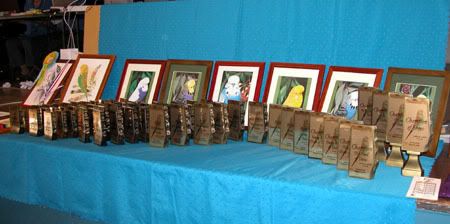

Here are some Troffies from the last Show I was at.
-
Edited by daz
To move the birds overseas, they all need some form of identification. Poe's getting microchipped (I had the vet remove her band, it was bothering her to no end) and Frankie's got a closed band. My little guys (budgies and cockatiel) need open leg bands though as they're way too small to be chipped.I've found plenty of places to order the bands but what I'd like to know is: Am I going to be able to apply these myself or would it be best to have a vet do it? How easy is it to do it wrong and what should I be careful of? Is there a special tool I should buy to put them on?
Also, most of the budgies are about two years old now. At this age, do birds get more annoyed with having a leg band since it's completely foreign to them? I really don't like doing this, I know open bands can be dangerous. But it's either this or leaving them here and I really don't want to do that.
Hi Terri
Most places that sell the open rings have the tool with them or at least availible. You slide the ring up the tool which opens it, place the tool a long the lower leg. Hold the ring in place and pull the tool out form the ring. The ring closed around the leg.
Some things to watch. Make sure the ring is around the leg before pulling out the tool. You don't want the ring clamping onto the leg.
The bird will squirm so it could be helpful to have a 2nd person do the tool and ring while you hold the bird and it's leg.
The bird will get annoyed at any age whether it is 7 days with a closed ring or 2 years with an open ring.
-
-
Arr this is where I show my true colours.... Honesty

I haven't got a clue on the point system.

I have trouble understand it when one of my birds is penalised as a netfeather for not being correctly marked but Markings and Colouring doesn't come into nestfeathers (chicks that have fledge but haven't gone through their first moult) because they moult out.
But a flecked head wins the division.
I will though find out this information and will post it.
-
-
Would it be feasible/possible for a person who only breeds a few birds to successfully breed show birds? I mean, if they didn't have the space for a huge aviary but had a large indoor setup and say, less than ten birds, could they somehow still do well in showing birds if they started off with a few pairs from good stock?
Yes they could Terri. They would have to have good birds to start with and the will power in deciding which offspring to keep and which to cull. But they could do well.
I bought two birds, paired them and in their first clutch was the chick that came 2nd in it's class.
English Vs. American Keets
in Breeders Discussion
Very nice.